
Help4 Performance, Cache and Asset Optimization
Before changing settings
Confirm the site, user state, current version, and recovery path.
Open the exact site and feature named in the request, record its current behavior, and keep a bounded recovery option. Change one setting group at a time so the verification can identify what actually changed.
Target
Record the domain, URL or admin screen, user role, viewport, and specific outcome before changing configuration.
Current state
Capture the relevant version, enabled module, existing value, and a fresh public or runtime check.
Recovery
Keep the previous immutable package, WordPress revision, export, or narrow data snapshot needed for this feature.
Privacy
Keep credentials, private customer data, payment secrets, nonces, and protected files out of screenshots and support reports.
Visual orientation
Match the screen before following the steps.
Open each image at full size. The numbered notes explain what the screen controls and what to confirm before changing customer content.
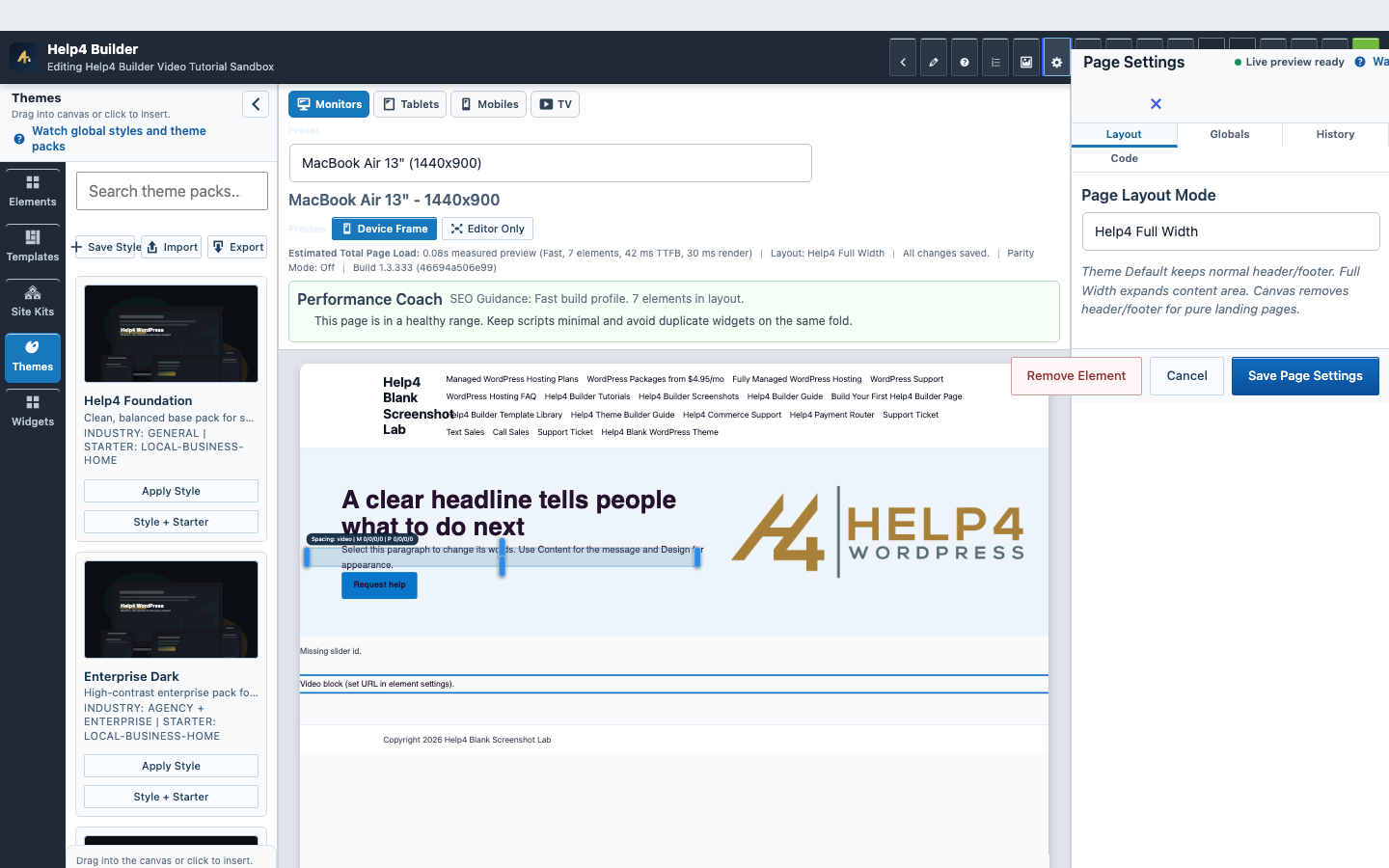
Screen 1
Page Settings and recovery
Confirm page-level layout, history, preview, and recovery controls before a larger edit.
Confirm: the page title, selected item, plugin version, and intended responsive view match the task.
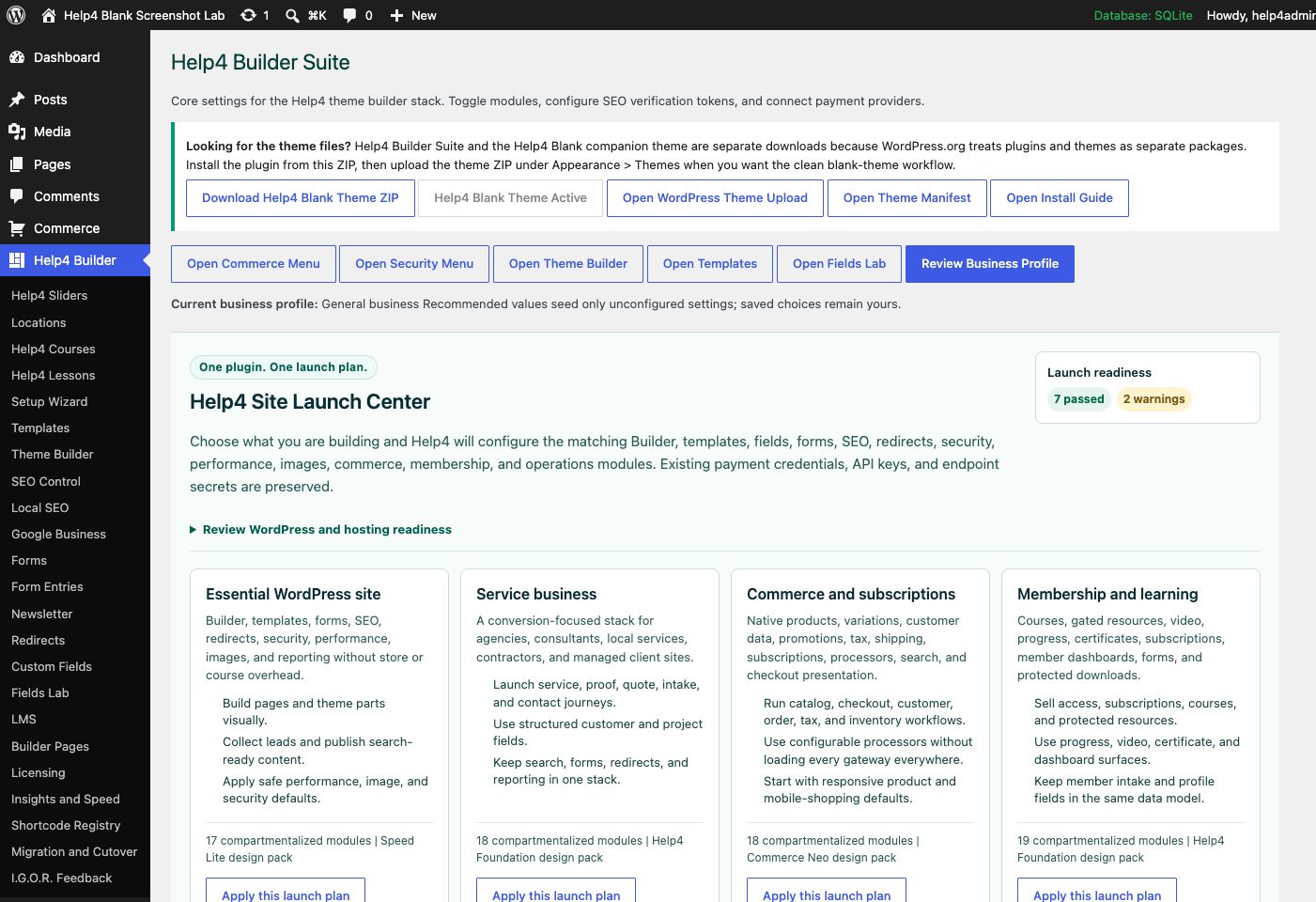
Screen 2
Settings and launch center
Choose a launch plan, confirm modules, download Help4 Blank, review readiness, and keep the site configuration in one place.
Confirm: the page title, selected item, plugin version, and intended responsive view match the task.
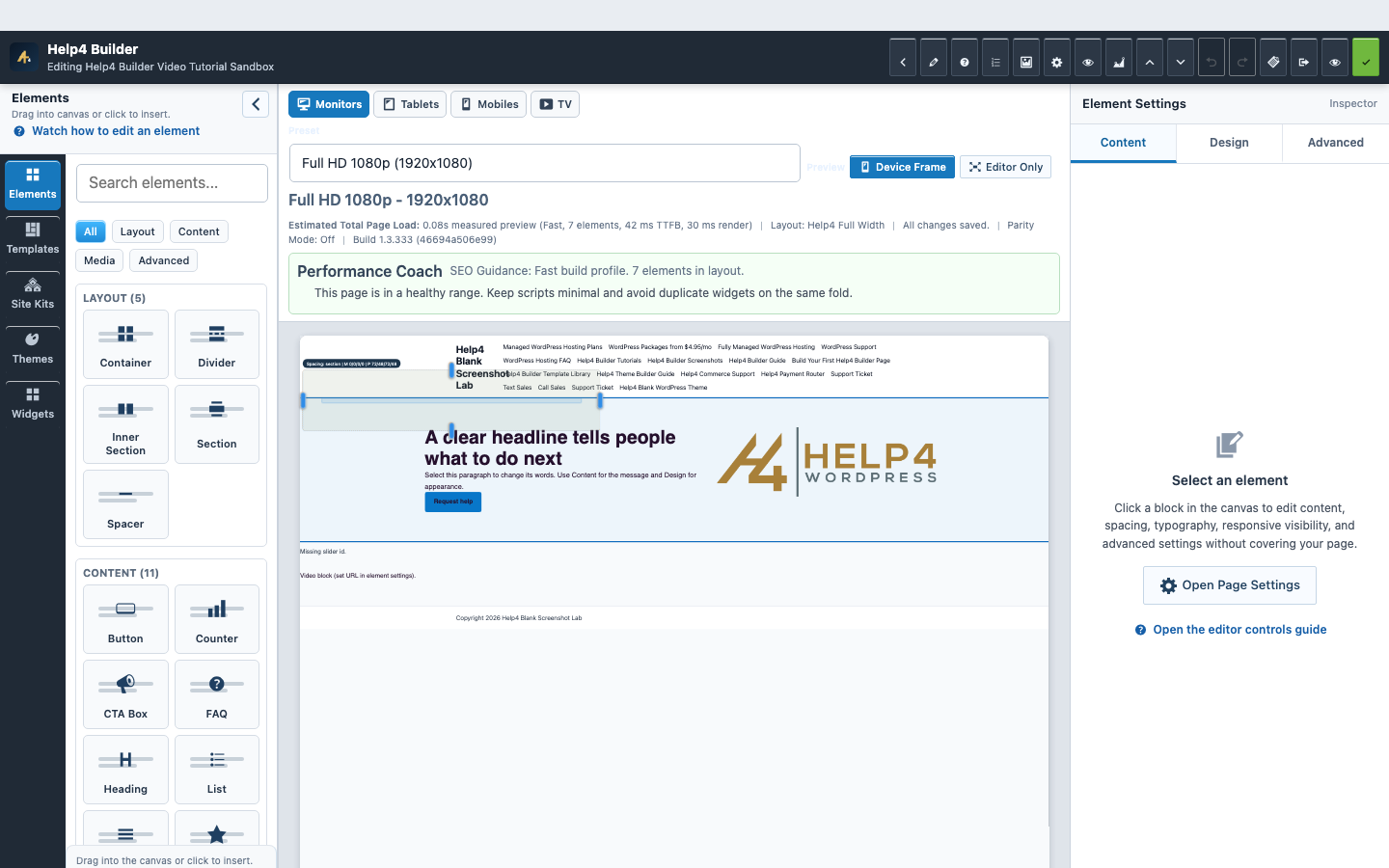
Screen 3
Current Studio workspace
See the element library, device controls, live page frame, inspector, performance guidance, and save state together.
Confirm: the page title, selected item, plugin version, and intended responsive view match the task.
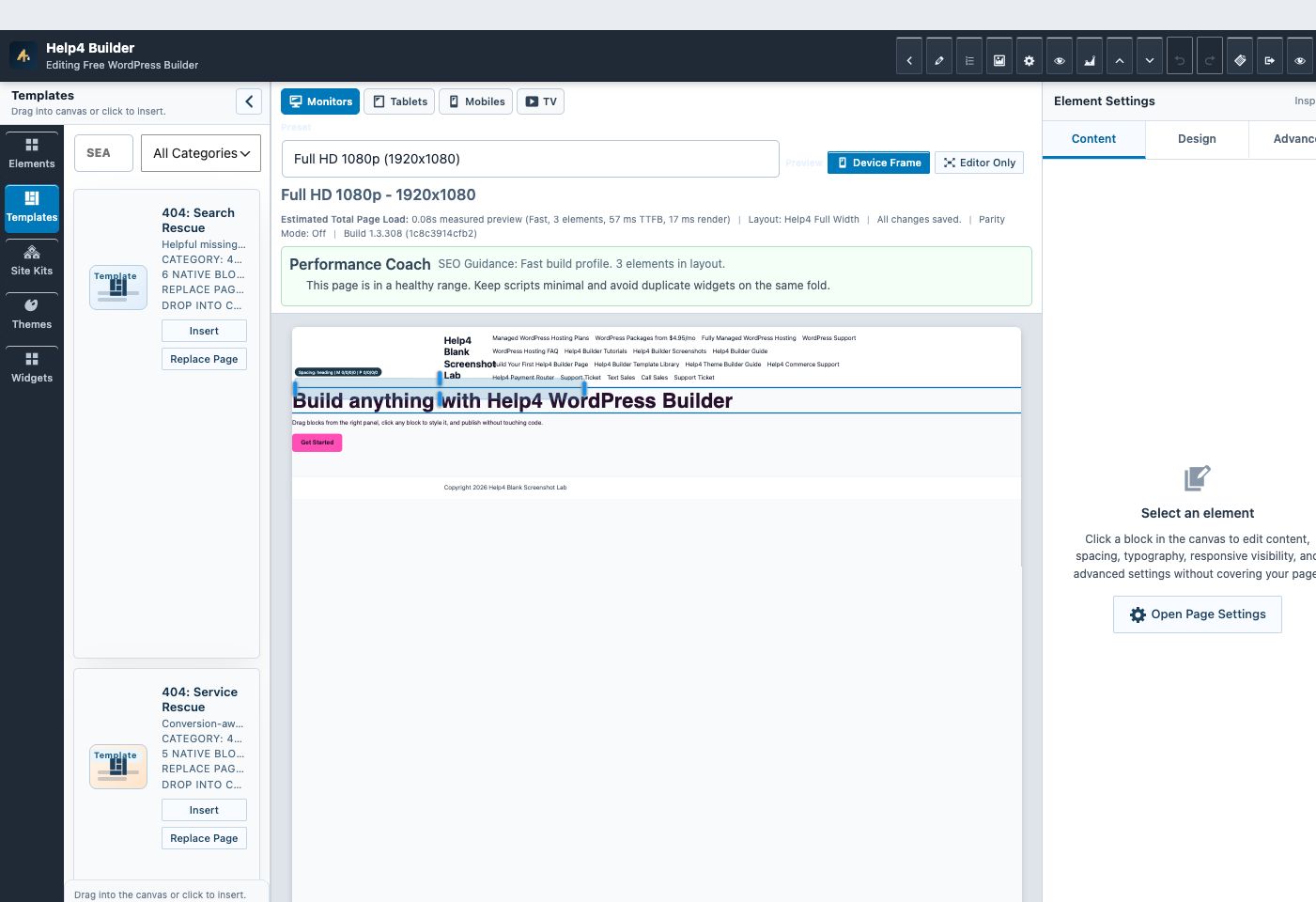
Screen 4
Builder Studio
Use the live page frame, element library, template library, inspector, responsive controls, performance guidance, and save state in one workspace.
Confirm: the page title, selected item, plugin version, and intended responsive view match the task.
Watch the real workflow
Watch the clicks before making the change.
Use the narrated walkthrough first, then follow the written steps and verification checks on this page.
Lesson 47
Cache, Assets, and Performance Diagnostics
Measure cold and warm behavior, reduce unused work, preserve bypass rules, and verify interactions instead of chasing one score.
Read the complete transcript
- Measure a Real Route
Choose a representative public route and record cold and warm response time, rendered content, transfer size, requests, long tasks, layout shifts, largest content, interaction behavior, and server logs. Test anonymously and use the same route and viewport for the before and after comparison.
- Reduce Unused Work
Optimize the media actually rendered, use responsive sources, preserve useful lazy loading, and enable only the Builder modules the page needs. Keep component styles and scripts tied to their widgets or module contracts rather than loading every commerce, learning, slider, form, or administration asset on every page.
- Protect Cache Boundaries
Cache public read-only pages where appropriate, but preserve bypass behavior for administration, previews, signed-in sessions, carts, checkout, account pages, forms, query-sensitive routes, webhooks, and personalized content. A fast cached response is wrong when it contains another visitor state or stale post-save output.
- Warm and Recheck Behavior
Purge only the affected route or site scope, request it cold, confirm the new content fingerprint, then request it warm and compare. Test menus, FAQ, sliders, video, forms, search, cart, responsive layout, and reduced motion. Keep the change only when public behavior and fresh logs remain correct as well as the performance evidence.
Lesson 26
Navigator, Layers, and Reusable Sections
Read the complete transcript
- Read the Element Tree
Open Navigator when the canvas is crowded or an element is hard to click. Read the parent, slot, and child relationships before moving anything. Select the exact heading, image, button, column, or section by name so a small content update never removes the surrounding page structure.
- Name Important Layers
Give major sections and reusable elements descriptive names. Names such as Home Hero, Pricing Grid, or Contact Button make later support and team editing much safer than a long list of generic sections. Keep stable element identifiers when replacing content so responsive values and extension data remain connected.
- Reuse the Right Structure
Use a section or page template when the same structure belongs in several places. Insert a reviewed starter, then replace its sample copy, media, links, and accessibility text. Reuse should reduce repeated work without turning every page into an identical block of unrelated content.
- Manage Shared Templates
Use Builder Templates and Theme Builder for headers, footers, page shells, archives, search, 404 pages, and other shared layouts. Confirm the role and display conditions before publishing. A shared template change can reach many routes, so test one matching and one nonmatching page before completing the update.
Performance evidence
A fast status code is not enough if the page shifts, clips, or stops responding.
Measure public visitor behavior, asset cost, visual stability, and required interactions before and after each optimization.
Module scope
Disable unused modules and confirm each enabled feature loads assets only where its output appears.
Cache truth
Distinguish anonymous cacheable pages from logged-in, query, cart, checkout, preview, and cookie bypass requests.
Media cost
Deliver appropriately sized images, posters, and video fallbacks without lazy-loading the first meaningful visual.
Behavior parity
Retest menus, forms, sliders, video, search, cart, checkout, and Studio after defer or cache changes.
Guided walkthrough
Make one verified change at a time.
Each step includes the action, why it belongs in this order, and the checkpoint to verify before moving forward.
-
Choose representative routes
Select the home page, a content page, a media-heavy page, a form, and any search, account, cart, or checkout route.
Why nowStarting from a confirmed target prevents a correct edit from being applied to the wrong page, template, product, or responsive view.
Done whenThe choose representative routes result is visible, remains after reselecting the item, and has not changed unrelated content or styling.
-
Capture a baseline
Record cold and warm timing, transfer size, request count, key assets, cache headers, layout stability, console, and server errors.
Why nowCompleting and checking this step creates a known-good checkpoint before the next control changes the page state again.
Done whenThe capture a baseline result is visible, remains after reselecting the item, and has not changed unrelated content or styling.
-
Remove unused module cost
Disable only modules the site does not use, then verify no shortcode, widget, template, or route depended on them.
Why nowCompleting and checking this step creates a known-good checkpoint before the next control changes the page state again.
Done whenThe remove unused module cost result is visible, remains after reselecting the item, and has not changed unrelated content or styling.
-
Optimize media delivery
Right-size images and posters, confirm responsive sources, and reserve lazy loading for content below the initial viewport.
Why nowCompleting and checking this step creates a known-good checkpoint before the next control changes the page state again.
Done whenThe optimize media delivery result is visible, remains after reselecting the item, and has not changed unrelated content or styling.
-
Tune scripts and cache
Enable deferral and supported cache integrations one at a time while preserving dependency order and private-route bypass.
Why nowCompleting and checking this step creates a known-good checkpoint before the next control changes the page state again.
Done whenThe tune scripts and cache result is visible, remains after reselecting the item, and has not changed unrelated content or styling.
-
Purge and test cache states
Check first MISS, warm HIT, logged-in bypass, query bypass, cart or checkout bypass, and content freshness after a save.
Why nowCompleting and checking this step creates a known-good checkpoint before the next control changes the page state again.
Done whenThe purge and test cache states result is visible, remains after reselecting the item, and has not changed unrelated content or styling.
-
Compare the same matrix
Repeat the baseline at desktop and mobile and reject any change that improves a score while breaking layout or interaction.
Why nowThe final verification separates an editor preview from a result that is actually saved, responsive, interactive, and ready for visitors.
Done whenThe compare the same matrix result is visible, remains after reselecting the item, and has not changed unrelated content or styling.
Release check
Test the real public or member outcome, not only the settings screen.
Reopen the saved setting, run the intended workflow in the correct visitor state, test desktop and phone behavior where a frontend surface exists, and inspect fresh browser or PHP errors from the same attempt.
Persistence
The saved values remain correct after reload and do not overwrite newer settings from another session.
Public behavior
The intended visitor can complete the workflow and an unintended visitor cannot access protected output.
Responsive behavior
Controls, text, tables, media, dialogs, and focus stay visible and usable at 768px, 390px, and 360px.
Fresh evidence
The final request has the expected status, output, cache state, and no new related console or PHP error.
Common questions
Answers for the decisions that block this setup most often.
Should the first visible image be lazy loaded?
Usually no. The primary above-the-fold image or poster should be available promptly while lower content can use lazy loading.
Why test both cache HIT and MISS?
A warm cache can hide slow generation, while an uncached response can expose stale purge rules, server errors, or missing assets.
Can script deferral break a working page?
Yes. Deferral can change execution order, so menus, forms, sliders, search, video, commerce, and editor requests must be retested.
Continue learning
Use the next guide that matches the work in front of you.
The full tutorial hub remains available without repeating dozens of unrelated cards on this page.
Start here
Install and setup
Download the ZIP, activate Builder Suite, understand the blank-theme path, and run the first clean check.
First page
Build a page safely
Open Builder Pages, launch Studio, build structure first, check mobile, then publish or hand it to Help4.
Editor controls
Know which tab changes what
Use Content for information, Design for appearance and responsive values, and Advanced for identity, attributes, visibility, and motion.
Recovery
Edit without losing work
Replace media safely, recognize stale drafts, and restore a known-good page snapshot from Page Settings History.
Responsive
Control every viewport
Set spacing, widths, columns, alignment, and typography independently for desktop, tablet, and mobile.
Templates
Choose a starter
Pick a starter spec by page job: service, product, support, recent work, local SEO, launch, or checkout recovery.
Need a second set of eyes?
Send one complete, privacy-safe support record.
Include the affected URL or admin screen, current Builder version, user state, exact steps, expected result, actual result, and one screenshot or fresh error when available.