
Template workflow screenshots
Starter templates are easier to trust when customers can see the setup path.
These screenshots show how a starter moves from module setup into pages and Builder Studio, whether Help4 finishes the site or the customer keeps editing after launch.
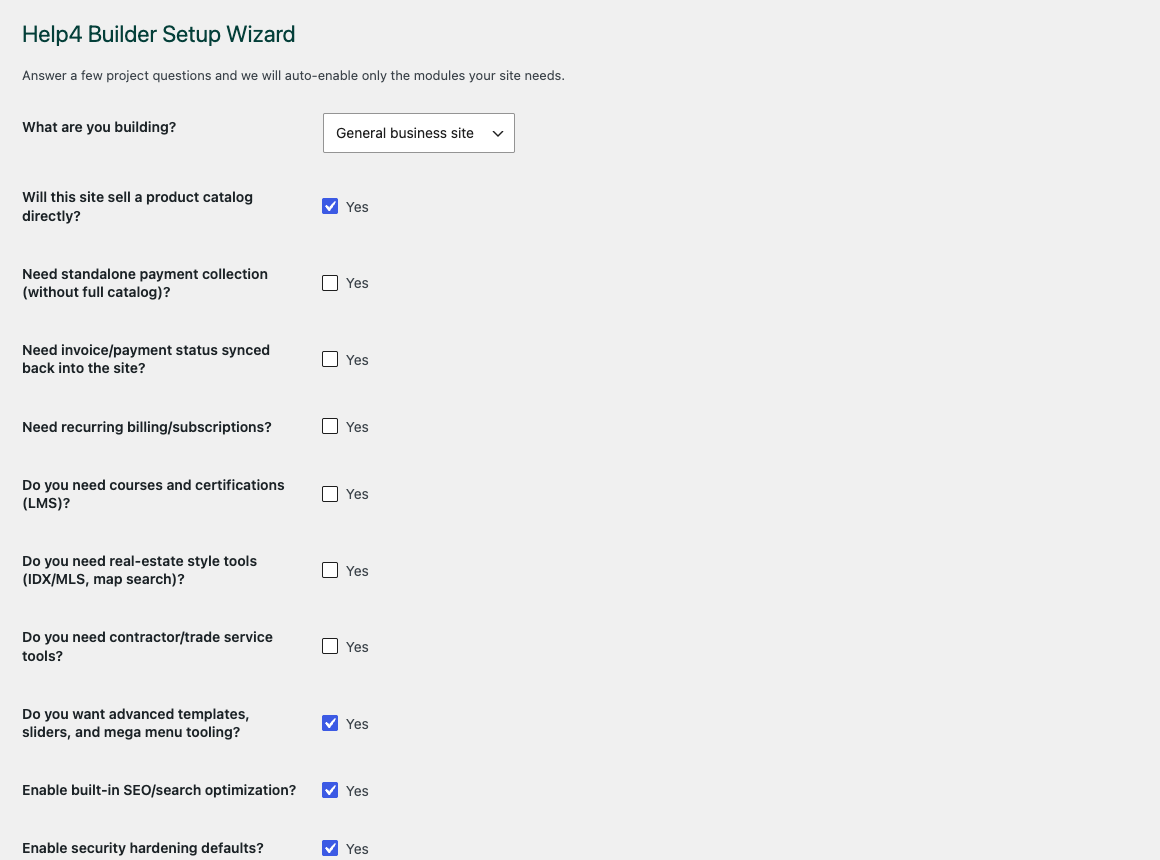
Setup wizard
Use the setup wizard to move a new site from blank WordPress into a builder-ready workflow without guessing what to open first.
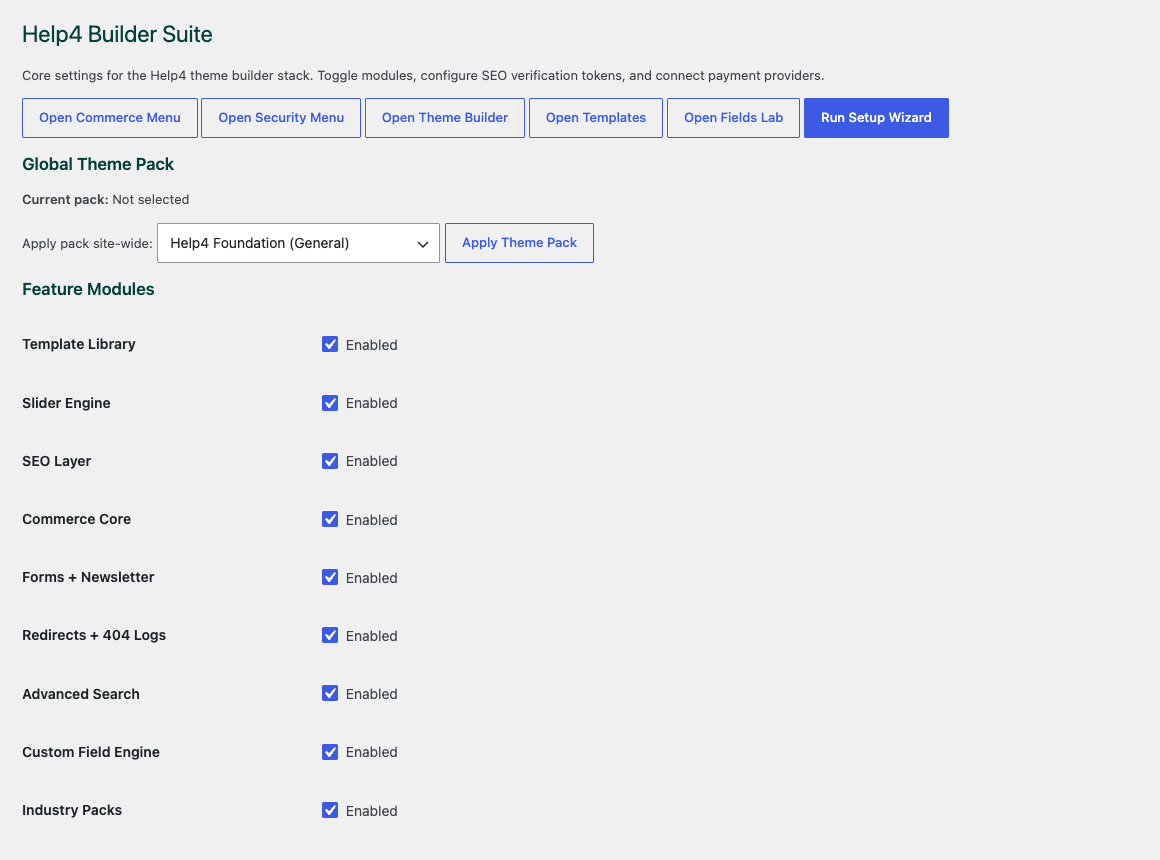
Settings dashboard
Start by choosing only the modules the site needs, so the build stays lean instead of loading every feature everywhere.
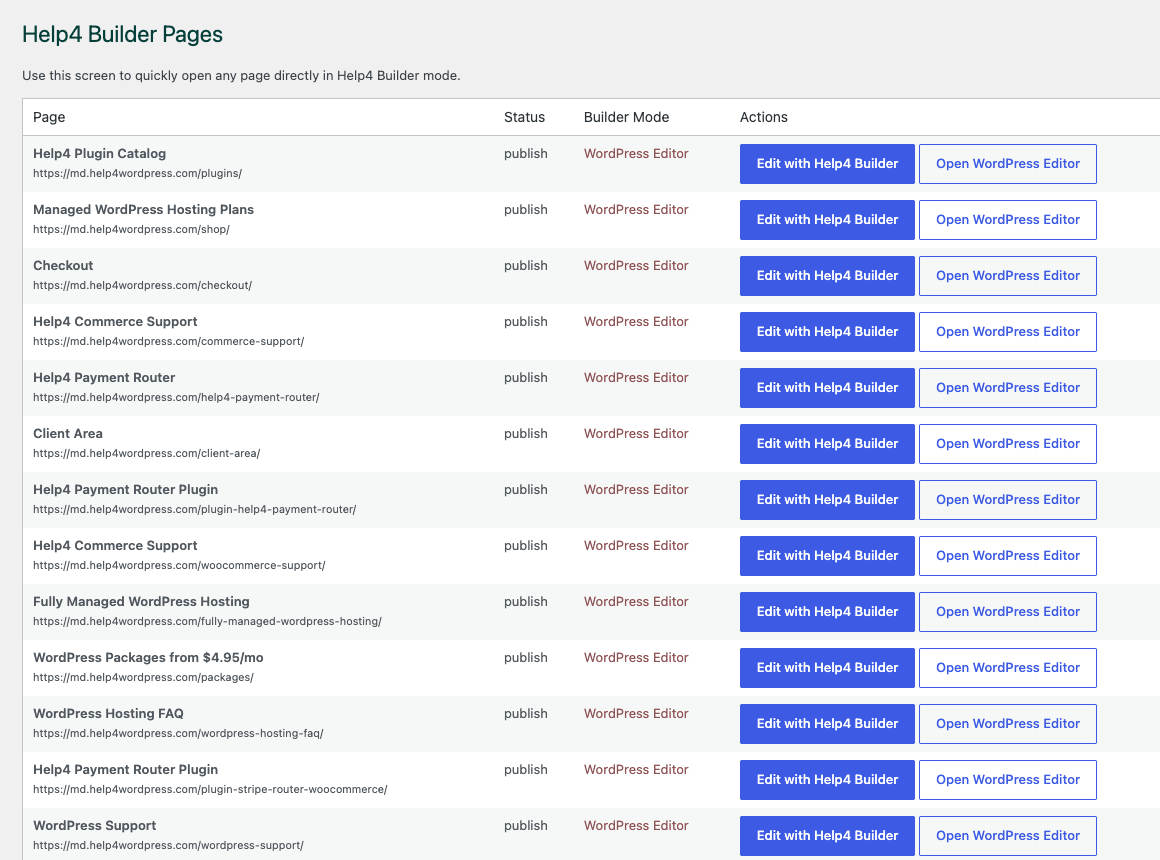
Builder Pages
Keep pages, landing screens, support content, product pages, and template work organized in one place.
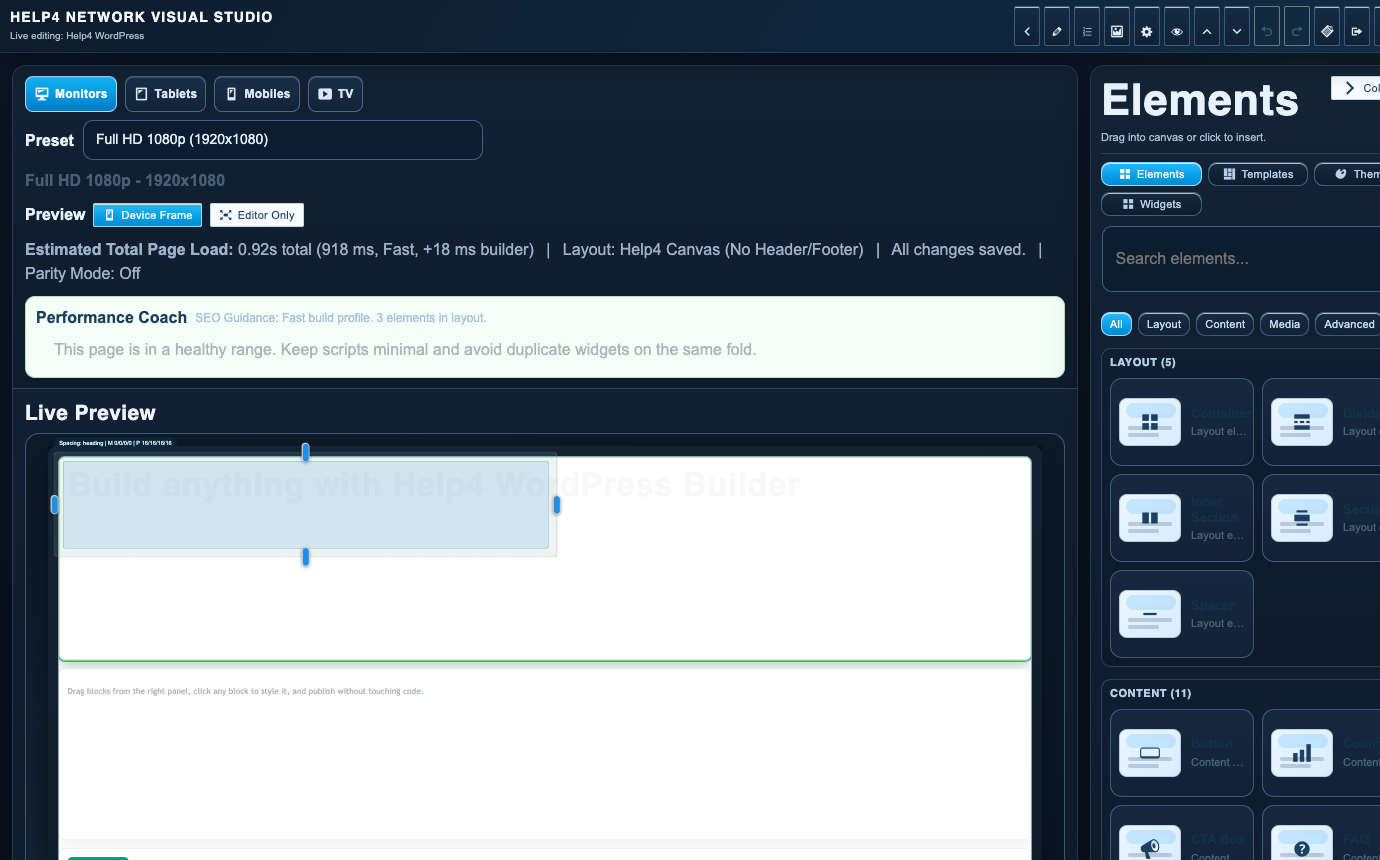
Builder Studio
Build the real page with sections, copy, visual checks, reusable structure, and a path back to support when needed.
How to use the library
Choose the closest outcome, then let Help4 adapt the page.
Every starter is meant to shorten the blank-page problem. Keep the structure, swap the copy, wire the forms, attach checkout or ticket links, and publish with Help4 SEO and performance defaults already in the workflow.
DIY builders
Use the template as a page map. Replace the examples with your offer, service area, pricing, screenshots, photos, and calls to action.
Business owners
Send Help4 the page goal, rough notes, logo, and examples. We can turn the starter into a finished page without making you learn the builder first.
Agencies
Start from repeatable structures for local service clients, commerce pages, support portals, launch pages, and white-label production runs.
Template browser
Browse the current starter set.
Use the filters below to find a template family, then open a setup request if you want Help4 to build the first version with your real copy, images, products, forms, and checkout path.
Starter Template Library
Plain-language starters for headers, footers, 404s, page shells, canvas landing pages, service sites, support pages, SEO, commerce, subscriptions, payment routing, builder onboarding, and launch work.
Accessibility Remediation Page
Service page for audits, fixes, readable forms, contrast, keyboard paths, and practical remediation.
Best for: urgent fixes, site care, migrations, cleanup, support routing, and operational trust pages.
Use when: customers need answers, setup steps, and support paths before opening another ticket.
Next step: group the top articles by customer problem, link setup tutorials, and keep the support request path obvious.
Spec outline
- Accessibility Hero
- Accessibility Audit Grid
- Remediation Plan
- Faq Schema
Account Login Rescue 404 Template
404 for account, download, and billing paths with login recovery, docs, latest download, and support escalation.
Best for: missing pages that should recover visitors with search, support links, product routes, and helpful next steps.
Use when: a broken or old URL should send people somewhere useful instead of dumping them into a dead end.
Next step: copy the 404 spec, set the role and scope to 404, add search/support/product links, then test an old URL.
Spec outline
- Account 404 Hero
- Account Route Grid
- Account Rescue Support Cta
Agency Mega Menu Header Template
Header pattern for service catalogs, documentation links, case studies, and account/support routes.
Best for: global navigation, phone/contact bars, primary CTAs, service menus, and first-click trust on every page.
Use when: the site needs a reusable top bar that makes the brand, offer, menu, and next action obvious on mobile and desktop.
Next step: copy the header spec, set the role to Header, map the menu and CTA, then check wrapping at mobile width before publishing.
Spec outline
- Mega Menu Navigation
- Mega Menu Feature Card
- Header Action Group
Agency Overflow / White-Label Page
Agency support page for design teams, freelancers, SEO teams, maintenance queues, and implementation overflow.
Best for: blank-theme builds, reusable templates, field groups, motion sections, and builder onboarding.
Use when: customers need answers, setup steps, and support paths before opening another ticket.
Next step: group the top articles by customer problem, link setup tutorials, and keep the support request path obvious.
Spec outline
- Agency Overflow Hero
- Handoff Grid
- Agency Process
- Agency Call Cta
App Download Footer Template
Footer for plugin, software, and digital-product sites with latest download, docs, changelog, and support links.
Best for: sitewide closing sections, support links, policy links, local proof, newsletter CTAs, and final conversion paths.
Use when: visitors reach the end of a page and still need contact options, trust cues, location/service links, and support routes.
Next step: copy the footer spec, set the role to Footer, replace policy/support links, and make sure the columns collapse cleanly on mobile.
Spec outline
- Footer Download Card
- Footer Resource Links
- Footer Legal Compact
Appointment Booking Header Template
Header for appointment-heavy sites with service picker, phone cue, booking CTA, and compact mobile navigation.
Best for: global navigation, phone/contact bars, primary CTAs, service menus, and first-click trust on every page.
Use when: the site needs a reusable top bar that makes the brand, offer, menu, and next action obvious on mobile and desktop.
Next step: copy the header spec, set the role to Header, map the menu and CTA, then check wrapping at mobile width before publishing.
Spec outline
- Booking Header Utility Row
- Booking Primary Nav
- Booking Mobile Action Bar
Appointment Booking Page
Booking-first service page for consultations, repair calls, demos, estimates, and calendar-driven intake.
Best for: urgent fixes, site care, migrations, cleanup, support routing, and operational trust pages.
Use when: customers need answers, setup steps, and support paths before opening another ticket.
Next step: group the top articles by customer problem, link setup tutorials, and keep the support request path obvious.
Spec outline
- Booking Hero
- Availability Panel
- Intake Checklist
- Confirmation Next Steps
Article and Tutorial Page Template
Readable post/page template with table of contents, screenshot slots, steps, FAQ, and support escalation.
Best for: blank-theme builds, reusable templates, field groups, motion sections, and builder onboarding.
Use when: customers need answers, setup steps, and support paths before opening another ticket.
Next step: group the top articles by customer problem, link setup tutorials, and keep the support request path obvious.
Spec outline
- Article Tutorial Hero
- Article Table Of Contents
- Screenshot Step List
- Tutorial Support Band
Before After Portfolio
Portfolio starter for before/after screenshots, project notes, measured improvements, testimonial, and similar-work CTA.
Best for: SEO landing pages, local service pages, proof sections, lead capture, and conversion paths.
Use when: you need to show the real work, the problem, the result, and why someone should trust the next project to you.
Next step: drop in screenshots, timeline, outcome metrics, and the final customer-facing call to action.
Spec outline
- Before After Hero
- Before After Gallery
- Project Story Grid
- Portfolio Conversion Cta
Blank Theme Homepage
Homepage starter made for the Help4 blank-theme workflow with global header, footer, content bands, and safe spacing defaults.
Best for: sitewide closing sections, support links, policy links, local proof, newsletter CTAs, and final conversion paths.
Use when: visitors reach the end of a page and still need contact options, trust cues, location/service links, and support routes.
Next step: copy the footer spec, set the role to Footer, replace policy/support links, and make sure the columns collapse cleanly on mobile.
Spec outline
- Blank Theme Hero
- Service Card Band
- Trust Proof Strip
- Footer Ready Cta
Blank Theme Launch Page
Hello-style blank theme launch starter for global parts, display rules, responsive QA, and publish checklists.
Best for: blank-theme builds, reusable templates, field groups, motion sections, and builder onboarding.
Use when: a buyer is comparing options and needs the differences, risks, and value explained without sales fog.
Next step: replace the rows with real buyer objections, pricing anchors, decision criteria, and one primary consultation action.
Spec outline
- Blank Theme Hero
- Global Template Map
- Display Condition Guide
- Responsive Publish Checklist
Booking Request Page
Booking starter for appointment requests, service choices, calendar expectations, deposits, and confirmation copy.
Best for: checkout routing, processor rules, payment confidence, and configured checkout handoff pages.
Use when: checkout needs trust, clear steps, payment routing, and a clean handoff to the account system.
Next step: explain payment steps, recovery paths, account access, and where the customer lands after checkout.
Spec outline
- Booking Hero
- Booking Service Picker
- Booking Detail Form
- Booking Confirmation Band
Booking Rescue 404 Template
Appointment-focused 404 with booking CTA, service selector, phone fallback, and common service links.
Best for: missing pages that should recover visitors with search, support links, product routes, and helpful next steps.
Use when: a broken or old URL should send people somewhere useful instead of dumping them into a dead end.
Next step: copy the 404 spec, set the role and scope to 404, add search/support/product links, then test an old URL.
Spec outline
- Booking 404 Hero
- Booking Service Rescue Grid
- Booking Rescue Cta
Build From Design Page
For customers who send Figma, screenshots, sketches, copy, or rough instructions.
Best for: blank-theme builds, reusable templates, field groups, motion sections, and builder onboarding.
Use when: a builder page needs structure, brand tokens, reusable sections, fields, media, or motion without bloating every page.
Next step: copy the starter spec, set global styles, replace sample content, and confirm mobile spacing before launch.
Spec outline
- Design To Wordpress Hero
- Artifact Grid
- Deliverable Grid
Builder First Page
First-run starter for non-technical users who need a safe hero, proof, service cards, contact CTA, and publish checklist.
Best for: blank-theme builds, reusable templates, field groups, motion sections, and builder onboarding.
Use when: you need to show the real work, the problem, the result, and why someone should trust the next project to you.
Next step: drop in screenshots, timeline, outcome metrics, and the final customer-facing call to action.
Spec outline
- First Page Hero
- Starter Proof Row
- Plain Setup Steps
- Publish Checklist Cta
Builder Quickstart Home Page
First-day builder starter for setup, blank theme pairing, starter selection, responsive checks, and publish path.
Best for: large product catalogs, variation choices, product imports, and store pages customers can understand.
Use when: a finished job needs proof, reviews, follow-up links, and a softer path back to the business.
Next step: connect review destinations, add two or three proof points, and publish it as a follow-up link after completed work.
Spec outline
- Builder Quickstart Hero
- First Run Stepper
- Starter Path Grid
- Tutorial Link Band
Canvas Landing Page Template
No-header/no-footer landing template for campaigns, lead magnets, paid traffic, and focused offers.
Best for: global navigation, phone/contact bars, primary CTAs, service menus, and first-click trust on every page.
Use when: the site needs a reusable top bar that makes the brand, offer, menu, and next action obvious on mobile and desktop.
Next step: copy the header spec, set the role to Header, map the menu and CTA, then check wrapping at mobile width before publishing.
Spec outline
- Canvas Offer Hero
- Landing Proof Stack
- Focused Lead Form
- Landing Final Cta
Case Study Page
Case-study starter for problem, work performed, screenshots, measurable outcome, testimonial, and next CTA.
Best for: SEO landing pages, local service pages, proof sections, lead capture, and conversion paths.
Use when: a finished job needs proof, reviews, follow-up links, and a softer path back to the business.
Next step: connect review destinations, add two or three proof points, and publish it as a follow-up link after completed work.
Spec outline
- Case Study Hero
- Before After Story Grid
- Outcome Metric Row
- Similar Project Cta
Catalog Command Commerce Design
High-volume commerce layout for filters, variations, subscriptions, comparisons, stock states, and checkout routing.
Best for: plans, memberships, renewals, trials, setup fees, and recurring checkout pages.
Use when: customers need answers, setup steps, and support paths before opening another ticket.
Next step: group the top articles by customer problem, link setup tutorials, and keep the support request path obvious.
Spec outline
- Catalog Command Intro
- Filterable Product Command Grid
- Commerce Capability Rail
- Checkout And Support Split
Checkout Bridge Page
Clean account/checkout bridge that sends buyers to Help4 Network without exposing internal billing labels.
Best for: checkout routing, processor rules, payment confidence, and configured checkout handoff pages.
Use when: customers need answers, setup steps, and support paths before opening another ticket.
Next step: group the top articles by customer problem, link setup tutorials, and keep the support request path obvious.
Spec outline
- Checkout Router
- Plan Choice Cards
- Support Link Band
Checkout Recovery Page
Support and trust page for failed payments, abandoned checkout, webhook status, retry flows, and customer help.
Best for: checkout routing, processor rules, payment confidence, and configured checkout handoff pages.
Use when: customers need answers, setup steps, and support paths before opening another ticket.
Next step: group the top articles by customer problem, link setup tutorials, and keep the support request path obvious.
Spec outline
- Checkout Help Hero
- Payment Status Grid
- Webhook Health Strip
- Checkout Support Cta
Clean Service Header Template
Simple sitewide header with logo, primary navigation, phone/contact cue, and one clear service CTA.
Best for: global navigation, phone/contact bars, primary CTAs, service menus, and first-click trust on every page.
Use when: the site needs a reusable top bar that makes the brand, offer, menu, and next action obvious on mobile and desktop.
Next step: copy the header spec, set the role to Header, map the menu and CTA, then check wrapping at mobile width before publishing.
Spec outline
- Service Utility Bar
- Clean Primary Navigation
- Header Action Button
Client Onboarding Checklist
Post-purchase onboarding page for account access, site details, assets, contacts, and first ticket steps.
Best for: checkout routing, processor rules, payment confidence, and configured checkout handoff pages.
Use when: customers need answers, setup steps, and support paths before opening another ticket.
Next step: group the top articles by customer problem, link setup tutorials, and keep the support request path obvious.
Spec outline
- Onboarding Hero
- Client Onboarding Checklist
- Account Route Grid
- First Ticket Cta
Client Portal Bridge Page
Account, invoice, ticket, and checkout bridge page that keeps billing language clean and branded.
Best for: checkout routing, processor rules, payment confidence, and configured checkout handoff pages.
Use when: customers need answers, setup steps, and support paths before opening another ticket.
Next step: group the top articles by customer problem, link setup tutorials, and keep the support request path obvious.
Spec outline
- Client Area Hero
- Portal Route Grid
- Support Routing Note
- Client Portal Cta
Commerce Account Footer Template
Footer for product and subscription sites with account, checkout, refund, support, and delivery routes.
Best for: sitewide closing sections, support links, policy links, local proof, newsletter CTAs, and final conversion paths.
Use when: visitors reach the end of a page and still need contact options, trust cues, location/service links, and support routes.
Next step: copy the footer spec, set the role to Footer, replace policy/support links, and make sure the columns collapse cleanly on mobile.
Spec outline
- Footer Commerce Link Grid
- Footer Commerce Trust Row
- Footer Account Cta
Commerce Security Hardening Page
Security starter for checkout trust, processor fallback, suspicious order review, backups, and site health.
Best for: checkout routing, processor rules, payment confidence, and configured checkout handoff pages.
Use when: customers need answers, setup steps, and support paths before opening another ticket.
Next step: group the top articles by customer problem, link setup tutorials, and keep the support request path obvious.
Spec outline
- Commerce Security Hero
- Commerce Risk Grid
- Security Hardening Plan
- Support Ticket Cta
Comparison Buyer Guide Page
Buyer-guide starter for comparing plans, managed service levels, build options, risks, and next steps.
Best for: a clean first draft when a customer needs a page structure they can hand off and publish faster.
Use when: a buyer is comparing options and needs the differences, risks, and value explained without sales fog.
Next step: replace the rows with real buyer objections, pricing anchors, decision criteria, and one primary consultation action.
Spec outline
- Buyer Guide Hero
- Plan Comparison Matrix
- Decision Risk Grid
- Recommended Path Cta
Content Brief Workflow Page
Client-friendly page for gathering copy, screenshots, files, goals, approvals, and launch-ready content.
Best for: blank-theme builds, reusable templates, field groups, motion sections, and builder onboarding.
Use when: a builder page needs structure, brand tokens, reusable sections, fields, media, or motion without bloating every page.
Next step: copy the starter spec, set global styles, replace sample content, and confirm mobile spacing before launch.
Spec outline
- Content Brief Hero
- Content Input Grid
- Approval Timeline
- Client Handoff Cta
Content Calendar Page
Content-planning starter for blog campaigns, service updates, launch announcements, social snippets, and SEO briefs.
Best for: SEO landing pages, local service pages, proof sections, lead capture, and conversion paths.
Use when: a local or service page needs search intent, proof, location relevance, and a clear next action.
Next step: copy the starter spec into a draft, swap the examples for real content, then run the SEO and mobile checks.
Spec outline
- Content Calendar Hero
- Campaign Calendar Grid
- Content Brief List
- Content Help Cta
Contractor Services Starter
Service-area, quote-first starter for contractors.
Best for: a clean first draft when a customer needs a page structure they can hand off and publish faster.
Use when: a visitor needs a fast way to ask for help, request pricing, or explain what they need before talking to you.
Next step: add service choices, location, urgency, budget, and route the form to the person who can reply fastest.
Spec outline
- Service Hero
- Service Grid
- Quote Form
Course / Membership Page
Starter for courses, memberships, private content, lessons, pricing, and student outcomes.
Best for: plans, memberships, renewals, trials, setup fees, and recurring checkout pages.
Use when: a buyer is comparing options and needs the differences, risks, and value explained without sales fog.
Next step: replace the rows with real buyer objections, pricing anchors, decision criteria, and one primary consultation action.
Spec outline
- Course Hero
- Lesson Outline
- Membership Pricing
- Student Faq
Course Membership Theme Kit
Inspiration kit for course headers, lesson pages, gated resources, member account routes, docs, and support recovery.
Best for: global navigation, phone/contact bars, primary CTAs, service menus, and first-click trust on every page.
Use when: the site needs a reusable top bar that makes the brand, offer, menu, and next action obvious on mobile and desktop.
Next step: copy the header spec, set the role to Header, map the menu and CTA, then check wrapping at mobile width before publishing.
Spec outline
- Kit Membership Course Header
- Kit Membership Lesson Page
- Kit Gated Resource Index
- Kit Account Login Rescue 404
Custom Field System Page
Field-system starter for groups, repeaters, galleries, relationships, conditional display, and dynamic templates.
Best for: blank-theme builds, reusable templates, field groups, motion sections, and builder onboarding.
Use when: a builder page needs structure, brand tokens, reusable sections, fields, media, or motion without bloating every page.
Next step: copy the starter spec, set global styles, replace sample content, and confirm mobile spacing before launch.
Spec outline
- Field System Hero
- Field Group Grid
- Dynamic Template Map
- Module Loading Note
Design Handoff Intake Page
Intake page for customers handing over Figma, screenshots, copy docs, competitor examples, or rough ideas.
Best for: large product catalogs, variation choices, product imports, and store pages customers can understand.
Use when: a large catalog or product family needs structure, filters, choices, and plain-language buying help.
Next step: define product groups, variation choices, filters, proof, and the checkout path before adding real inventory.
Spec outline
- Handoff Intake Hero
- Artifact Grid
- Handoff To Launch Timeline
- Project Intake Form
Design Handoff Landing Page
Landing-page starter for turning a design file, screenshot set, or rough brief into a production page request.
Best for: SEO landing pages, local service pages, proof sections, lead capture, and conversion paths.
Use when: a builder page needs structure, brand tokens, reusable sections, fields, media, or motion without bloating every page.
Next step: copy the starter spec, set global styles, replace sample content, and confirm mobile spacing before launch.
Spec outline
- Handoff Hero
- Handoff Intake Grid
- Responsive Handoff Checklist
- Build Request Cta
Digital Download Page
Download-delivery starter for software, files, license notes, changelog links, support instructions, and version proof.
Best for: urgent fixes, site care, migrations, cleanup, support routing, and operational trust pages.
Use when: customers need answers, setup steps, and support paths before opening another ticket.
Next step: group the top articles by customer problem, link setup tutorials, and keep the support request path obvious.
Spec outline
- Download Hero
- Download Card Stack
- Install Step List
- Download Support Band
Digital Product Theme Kit
Inspiration kit for plugin, download, subscription, release notes, docs, and account checkout pages.
Best for: global navigation, phone/contact bars, primary CTAs, service menus, and first-click trust on every page.
Use when: the site needs a reusable top bar that makes the brand, offer, menu, and next action obvious on mobile and desktop.
Next step: copy the header spec, set the role to Header, map the menu and CTA, then check wrapping at mobile width before publishing.
Spec outline
- Kit Product Header
- Kit Digital Product Page
- Kit Download Page
- Kit Release Notes Page
Documentation Footer Template
Footer for tutorials and docs with grouped setup links, popular articles, changelog, and support escalation.
Best for: sitewide closing sections, support links, policy links, local proof, newsletter CTAs, and final conversion paths.
Use when: visitors reach the end of a page and still need contact options, trust cues, location/service links, and support routes.
Next step: copy the footer spec, set the role to Footer, replace policy/support links, and make sure the columns collapse cleanly on mobile.
Spec outline
- Footer Popular Docs
- Footer Release Links
- Footer Support Route
Documentation Hub Page Template
Docs hub template with search, setup paths, screenshot tutorials, common fixes, and support escalation.
Best for: blank-theme builds, reusable templates, field groups, motion sections, and builder onboarding.
Use when: customers need answers, setup steps, and support paths before opening another ticket.
Next step: group the top articles by customer problem, link setup tutorials, and keep the support request path obvious.
Spec outline
- Docs Hub Hero Search
- Docs Path Card Grid
- Screenshot Tutorial Index
- Docs Support Escalation
Email Deliverability Fix Page
Service page for broken forms, missing receipts, SMTP, DNS records, notifications, and follow-up flows.
Best for: urgent fixes, site care, migrations, cleanup, support routing, and operational trust pages.
Use when: customers need answers, setup steps, and support paths before opening another ticket.
Next step: group the top articles by customer problem, link setup tutorials, and keep the support request path obvious.
Spec outline
- Email Fix Hero
- Delivery Symptom Grid
- Email Fix Timeline
- Support Ticket Cta
Emergency WordPress Fix Page
Urgent support page for site-down, broken checkout, failed forms, launch blockers, and plugin conflicts.
Best for: urgent fixes, site care, migrations, cleanup, support routing, and operational trust pages.
Use when: a buyer is comparing options and needs the differences, risks, and value explained without sales fog.
Next step: replace the rows with real buyer objections, pricing anchors, decision criteria, and one primary consultation action.
Spec outline
- Urgent Support Hero
- Issue Triage Grid
- Support Ticket Guide
- Emergency Cta
Enterprise Product Import Page
Large-catalog starter for imports, mappings, variations, subscriptions, processor routing, and operations review.
Best for: plans, memberships, renewals, trials, setup fees, and recurring checkout pages.
Use when: a finished job needs proof, reviews, follow-up links, and a softer path back to the business.
Next step: connect review destinations, add two or three proof points, and publish it as a follow-up link after completed work.
Spec outline
- Catalog Import Hero
- Import Mapping Table
- Variation And Subscription Map
- Operations Review Cta
Event Registration Page
Event page with schedule, speakers, ticket tiers, venue details, and registration CTA.
Best for: checkout routing, processor rules, payment confidence, and configured checkout handoff pages.
Use when: checkout needs trust, clear steps, payment routing, and a clean handoff to the account system.
Next step: explain payment steps, recovery paths, account access, and where the customer lands after checkout.
Spec outline
- Event Hero
- Event Agenda
- Ticket Tier Cards
- Venue Details
FAQ Hub Page
FAQ hub starter for grouped questions, schema-ready answers, support routing, download links, and plain-language objections.
Best for: urgent fixes, site care, migrations, cleanup, support routing, and operational trust pages.
Use when: customers need answers, setup steps, and support paths before opening another ticket.
Next step: group the top articles by customer problem, link setup tutorials, and keep the support request path obvious.
Spec outline
- Faq Hub Hero
- Faq Topic Grid
- Faq Schema List
- Faq Support Cta
Full Width Page Shell Template
Page template for immersive sections with global header/footer, wide media, proof bands, and responsive spacing controls.
Best for: complete blank-theme starts with headers, footers, 404s, page shells, and reusable content parts.
Use when: a blank-theme site needs enough structure to feel designed before the owner replaces copy, colors, and screenshots.
Next step: copy the pieces you need first, assign header/footer/404 roles, then use the page shells as the site pattern library.
Spec outline
- Full Width Visual Hero
- Wide Proof Band
- Wide Section Stack
- Responsive Spacing Checklist
Global Style System Page
Style-system starter for colors, typography, spacing, buttons, responsive rules, and reusable brand defaults.
Best for: blank-theme builds, reusable templates, field groups, motion sections, and builder onboarding.
Use when: a finished job needs proof, reviews, follow-up links, and a softer path back to the business.
Next step: connect review destinations, add two or three proof points, and publish it as a follow-up link after completed work.
Spec outline
- Style System Hero
- Design Token Grid
- Component Preview Strip
- Responsive Style Checklist
Handled WordPress Design System
Editorial managed WordPress design with product-health hero, plain-language outcomes, plans, FAQ, and closing action.
Best for: large product catalogs, variation choices, product imports, and store pages customers can understand.
Use when: customers need answers, setup steps, and support paths before opening another ticket.
Next step: group the top articles by customer problem, link setup tutorials, and keep the support request path obvious.
Spec outline
- Two Column Product Health Hero
- Three Outcome Band
- Plain Language Plan Path
- Managed Service Faq
- Dark Closing Action Band
Help Center Theme Kit
Inspiration kit for documentation headers, article templates, FAQ hubs, 404 rescue, and support routing.
Best for: global navigation, phone/contact bars, primary CTAs, service menus, and first-click trust on every page.
Use when: the site needs a reusable top bar that makes the brand, offer, menu, and next action obvious on mobile and desktop.
Next step: copy the header spec, set the role to Header, map the menu and CTA, then check wrapping at mobile width before publishing.
Spec outline
- Kit Docs Header
- Kit Tutorial Article Template
- Kit Faq Index Page
- Kit Helpful 404
Help4 Commerce Catalog Page
Native commerce starter for large product catalogs, variations, subscriptions, checkout routing, and performance.
Best for: large product catalogs, variation choices, product imports, and store pages customers can understand.
Use when: you need to show the real work, the problem, the result, and why someone should trust the next project to you.
Next step: drop in screenshots, timeline, outcome metrics, and the final customer-facing call to action.
Spec outline
- Native Commerce Hero
- Large Catalog Proof
- Variation Matrix Explainer
- Checkout Router Cta
Help4 Commerce Support Page
Store support template for product catalogs, variations, checkout routing, subscriptions, emails, and performance.
Best for: checkout routing, processor rules, payment confidence, and configured checkout handoff pages.
Use when: customers need answers, setup steps, and support paths before opening another ticket.
Next step: group the top articles by customer problem, link setup tutorials, and keep the support request path obvious.
Spec outline
- Store Support Hero
- Commerce Issue Grid
- Checkout Flow Map
- Support Link Band
Helpful Support 404 Template
Not-found page that routes visitors to search, support, recent work, downloads, and the most useful next pages.
Best for: missing pages that should recover visitors with search, support links, product routes, and helpful next steps.
Use when: a broken or old URL should send people somewhere useful instead of dumping them into a dead end.
Next step: copy the 404 spec, set the role and scope to 404, add search/support/product links, then test an old URL.
Spec outline
- Helpful 404 Hero
- Not Found Search Panel
- Not Found Route Grid
Image Optimization Page
Performance page for oversized media, responsive images, lazy loading, product photos, and Core Web Vitals.
Best for: a clean first draft when a customer needs a page structure they can hand off and publish faster.
Use when: you want a working first draft instead of starting from a blank page and guessing what sections belong there.
Next step: copy the starter spec into a draft, swap the examples for real content, then run the SEO and mobile checks.
Spec outline
- Image Performance Hero
- Image Audit Grid
- Core Web Vitals Impact
- Speed Service Cta
Knowledge Base Index Page
Documentation index starter for grouping tutorials, setup guides, troubleshooting articles, and support escalation paths.
Best for: urgent fixes, site care, migrations, cleanup, support routing, and operational trust pages.
Use when: customers need answers, setup steps, and support paths before opening another ticket.
Next step: group the top articles by customer problem, link setup tutorials, and keep the support request path obvious.
Spec outline
- Knowledge Index Hero
- Topic Card Grid
- Popular Article List
- Support Escalation Band
Knowledge Base Support Hub
Help center starter with categories, popular fixes, ticket routing, search, and account links.
Best for: checkout routing, processor rules, payment confidence, and configured checkout handoff pages.
Use when: a buyer is comparing options and needs the differences, risks, and value explained without sales fog.
Next step: replace the rows with real buyer objections, pricing anchors, decision criteria, and one primary consultation action.
Spec outline
- Support Hub Hero
- Knowledge Category Grid
- Popular Fixes List
- Support Ticket Guide
Landing Page Stack Template
Reusable landing page stack with offer, objection handling, proof, CTA, FAQ, and conversion checks.
Best for: blank-theme builds, reusable templates, field groups, motion sections, and builder onboarding.
Use when: a finished job needs proof, reviews, follow-up links, and a softer path back to the business.
Next step: connect review destinations, add two or three proof points, and publish it as a follow-up link after completed work.
Spec outline
- Offer First Hero
- Objection Handling Grid
- Proof And Results Band
- Single Action Cta
Launch Announcement Page
Launch announcement starter for new sites, product releases, update notes, screenshots, signup CTA, and support links.
Best for: a clean first draft when a customer needs a page structure they can hand off and publish faster.
Use when: you want a working first draft instead of starting from a blank page and guessing what sections belong there.
Next step: copy the starter spec into a draft, swap the examples for real content, then run the SEO and mobile checks.
Spec outline
- Launch Announcement Hero
- Release Screenshot Grid
- Plain Release Note List
- Launch Followup Cta
Launch Checklist Page
Prelaunch QA page for staging, DNS, SSL, mobile checks, forms, redirects, and final approval.
Best for: a clean first draft when a customer needs a page structure they can hand off and publish faster.
Use when: you want a working first draft instead of starting from a blank page and guessing what sections belong there.
Next step: copy the starter spec into a draft, swap the examples for real content, then run the SEO and mobile checks.
Spec outline
- Launch Readiness Hero
- Launch Qa Checklist
- Dns Ssl Status Grid
- Launch Approval Cta
Lead Capture Landing Page
Focused landing page for paid traffic, offers, consultations, downloads, and urgent service requests.
Best for: checkout routing, processor rules, payment confidence, and configured checkout handoff pages.
Use when: checkout needs trust, clear steps, payment routing, and a clean handoff to the account system.
Next step: explain payment steps, recovery paths, account access, and where the customer lands after checkout.
Spec outline
- Conversion Hero
- Offer Stack
- Lead Form Panel
- Trust And Faq
Lead Intake Page
Lead-intake starter for collecting the URL, business goal, needed pages, design assets, budget signal, and contact route.
Best for: blank-theme builds, reusable templates, field groups, motion sections, and builder onboarding.
Use when: a visitor needs a fast way to ask for help, request pricing, or explain what they need before talking to you.
Next step: add service choices, location, urgency, budget, and route the form to the person who can reply fastest.
Spec outline
- Lead Intake Hero
- Lead Intake Field Map
- Lead Routing Summary
- Submit Intake Cta
Local Business Header Template
Local-service header with area cue, review proof, tap-to-call action, and service-menu layout.
Best for: global navigation, phone/contact bars, primary CTAs, service menus, and first-click trust on every page.
Use when: the site needs a reusable top bar that makes the brand, offer, menu, and next action obvious on mobile and desktop.
Next step: copy the header spec, set the role to Header, map the menu and CTA, then check wrapping at mobile width before publishing.
Spec outline
- Local Proof Header Strip
- Local Service Navigation
- Tap To Call Cta
No starter templates match that filter.